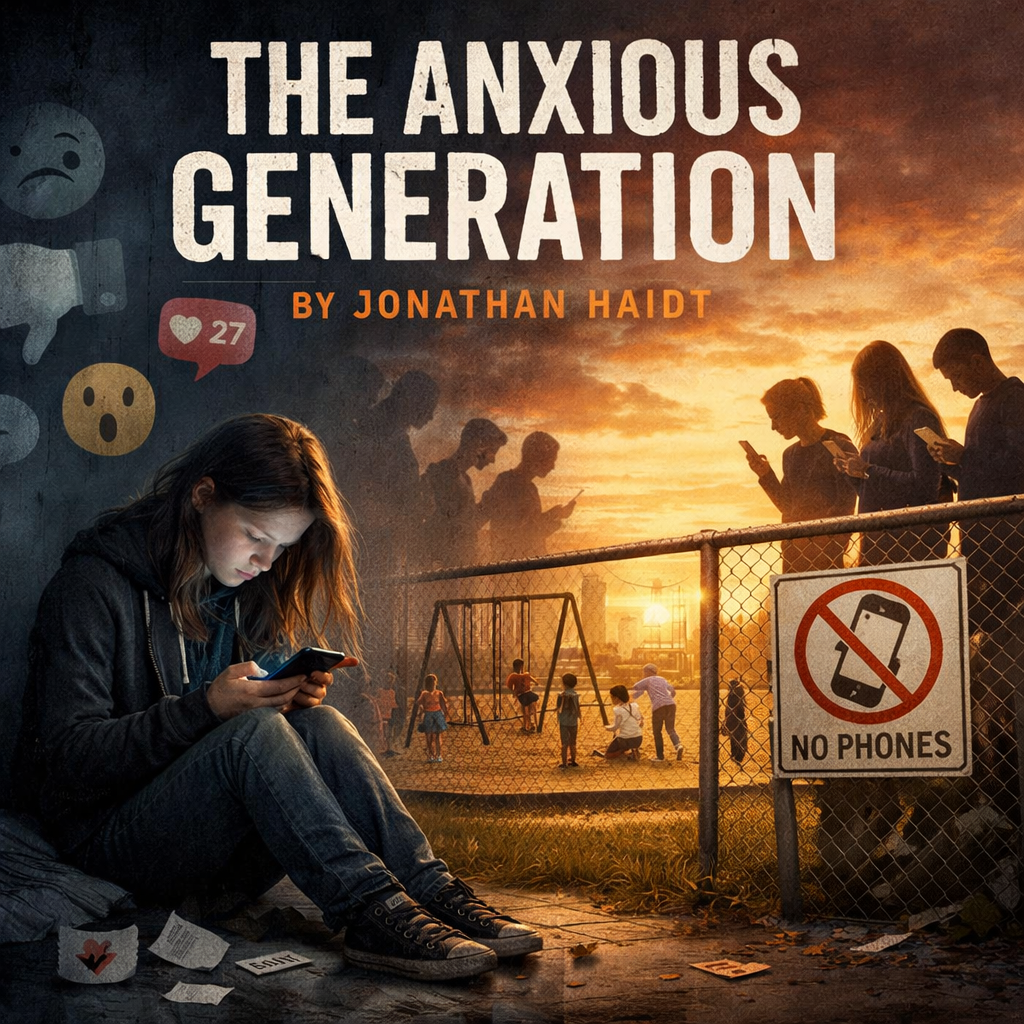
Would you send your child to Mars? It seems dangerous. It seems like it will have some significant risks. No one knows the long term effects. But everyone else is doing it… so then it is fine?
And that is exactly what happened with social media. And this is how the author Jonathan Haidt starts his book.
The Anxious Generation is one of those books that quietly removes your ability to stay neutral. By the time I finished it, continuing to treat social media as a mostly harmless feature of modern life felt increasingly difficult to justify.
Jonathan Haidt’s central argument is that childhood has been fundamentally altered in a very short period of time, and not for the better. Beginning in the early 2010s, two major shifts happened at once. Children lost freedom in the physical world through reduced play, independence, and risk-taking. At the same time, they were given near-total access to a digital world built around smartphones and social media. The world moved from play based childhood to phone based childhood. According to Haidt, this combination rewired childhood in ways that directly contributed to rising levels of anxiety, depression, and emotional fragility.
What makes the argument persuasive is how closely the timelines align. Rates of anxiety, self-harm, and depression among adolescents rise sharply just as smartphones and social media become nearly universal. While correlation alone is not proof, Haidt makes a strong case that it is no longer reasonable to dismiss this as coincidence. The patterns are too consistent and too widespread.
“This is the great irony of social media: the more you immerse yourself in it, the more lonely and depressed you become.”
― Jonathan Haidt, The Anxious Generation: How the Great Rewiring of Childhood Is Causing an Epidemic of Mental Illness
The book has many examples both on the harms for adults and for children. I was born in the 90s when the internet was unlimited, there was nothing safeguarding me from entering sites I should not have entered. For example, there were no age checks and when there were you could just say you were 18 by clicking a button. There was also no parental controls on the devices like there are now. Instagram launched teen accounts only in September 2024. So prior to this anyone could contact them via the messaging option and there were no limits on sensitive content either. How healthy is it\ to be scrolling your reels for hours? Reading The Anxious Generation forced me to reconsider my own relationship with social media and whether it was actually neutral or quietly shaping my attention and emotional state.
Social media, as presented in the book, is not simply a distraction. It causes real harm, particularly to children and teenagers whose brains are still developing. These platforms are engineered to maximize engagement, and addiction, rather than well-being. They encourage constant comparison, reward performative behavior, and keep users in a state of perpetual alertness. For adults this is draining. For children, it is destabilising.
“We don’t let preteens buy tobacco or alcohol, or enter casinos. The costs of using social media, in particular, are high for adolescents, compared with adults, while the benefits are minimal. Let children grow up on Earth first, before sending them to Mars.”
― Jonathan Haidt, The Anxious Generation: How the Great Rewiring of Childhood Is Causing an Epidemic of Mental Illness
As a result, I came off social media entirely at the beginning of 2025.
Once you accept Haidt’s argument that these platforms systematically fragment attention and elevate anxiety, continuing to use them out of habit starts to feel crazy. The change since stepping away has been noticeable. I got so much time back! I started reading books again, I started reading journals again, I picked my masters back up, I travelled and lived in the moment.
To Haidt’s credit, the book does not end with despair. He offers concrete and realistic recommendations such as delaying smartphones, delaying social media use, enforcing phone-free schools, and restoring play-based childhoods.
The Anxious Generation is not a comfortable book, and it should not be. It challenges the assumption that unlimited connectivity is harmless and forces the reader to confront the possibility that we have normalized something deeply unhealthy. Whether or not one agrees with every conclusion, the book makes one point very hard to ignore.
We are running a large-scale experiment on children, and the results are not encouraging. Maybe it is time for the children to just stay on earth.
For me, that was reason enough to log out.
How to Read The Anxious Generation
- This is a must-read if you care even a little bit about mental health, kids, or the future of society. You don’t need to be a parent. You don’t need to be an academic. If you’ve ever wondered “why does everyone seem so anxious now?” or ”why am I so anxious all the time” this book is for you.
- If you are here, you have either already noticed something is off, finished the book, or you don’t mind being mildly disturbed by statistics. In any case, spoilers don’t really exist here — the anxiety epidemic is very much out in the open.
- I would actually recommend reading this one slowly, not bingeing it. A chapter at a time works better than trying to power through. It’s not heavy prose, but the implications can be… a lot.
- If you enjoy books that connect psychology, data, and culture — and then quietly make you question how we’re raising an entire generation — you don’t need to look any further.
- Perhaps evaluate how much you use social media and apps such as TikTok, Facebook, Instagram per day (your phone will offer some very fascinating statistics)
How much social media do you use per day? What are your thoughts?
Image for the post has been created by ChatGPT.


Leave a Reply